With Plurai's vibe post-training, any engineer can turn an open-source model into a task-specific model that beats frontier LLMs, starting from a task description or a few examples. Plurai's platform runs the full pipeline, from synthetic data generation and post-training to benchmarking and inference optimization, on Nebius infrastructure built to train and serve at scale. For a global enterprise, we post-trained the NVIDIA Nemotron 3.5 Lightning open model to beat Claude Haiku-5.5 by more than 10 quality points at 44x lower cost, and to match OpenAI's GPT-6 Luna at 40x lower cost.
Frontier models are the right tool for complex, open-ended tasks, but running every workload on them gets expensive fast. Many enterprise workloads are domain-specific and high-volume, such as extraction, classification and routing, and these are where a post-trained open model performs better at a fraction of the cost. Building one has meant labelled data, a data science team and weeks of iteration, so most teams keep everything on the frontier model.
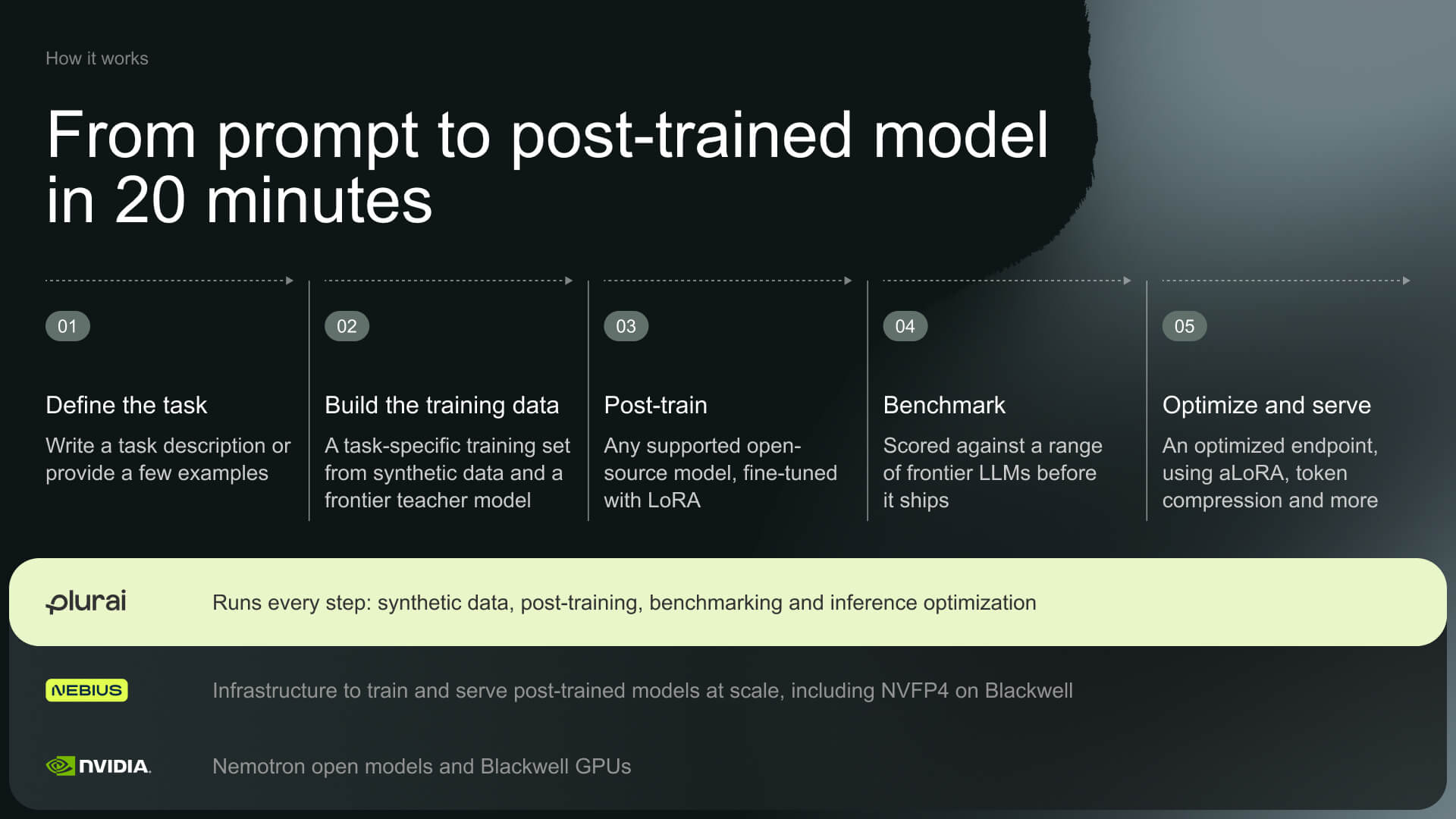
Plurai removes the friction with vibe post-training. From a task description or a few examples, any engineer can post-train any open-source model, from NVIDIA Nemotron to Qwen and Llama, in about 20 minutes and get a model that beats frontier models on cost and accuracy. It works through Plurai’s web UI or directly in the IDE with the Plurai Claude Code plugin. The novelty underneath is grounded in Plurai’s published research: BARRED (ICML 2026), its method for generating synthetic training data for post-training, builds the training set instead of waiting for one.
Plurai also optimizes how its models run in production. Techniques such as Activated LoRA (aLoRA), token compression and smart decoding let many task-specific models share a single GPU without slowing down. In Plurai's published benchmark, aLoRA with shared prefix caching evaluated 100 adapters against a 5,000-token conversation in 285 ms on one GPU, 32x faster than standard LoRA.
Plurai makes post-training accessible to any engineer, and Nebius scales it across the open models it supports. For one of Plurai's enterprise design partners, Plurai post-trained two open models, NVIDIA Nemotron 3.5 Lightning and Qwen3.5, and both matched or beat the frontier models tested. Nemotron 3.5 Lightning delivered the biggest saving: 44x lower cost than Claude Haiku-5.5 with 10 points higher quality, and 40x lower than GPT-6 Luna at matching quality.
What the collaboration unlocks:
The post-trained Nemotron 3.5 Lightning model outscored Claude Haiku-5.5 by 10.4 points on real production chats (88.8 vs. 78.4) and 18.3 points on the held-out set (91.0 vs. 72.7), at 44x lower cost. It matched OpenAI's GPT-6 Luna on real production chats (88.8 vs. 88.6) and led it by 10.8 points on the held-out set (91.0 vs. 80.2), at 40x lower cost.
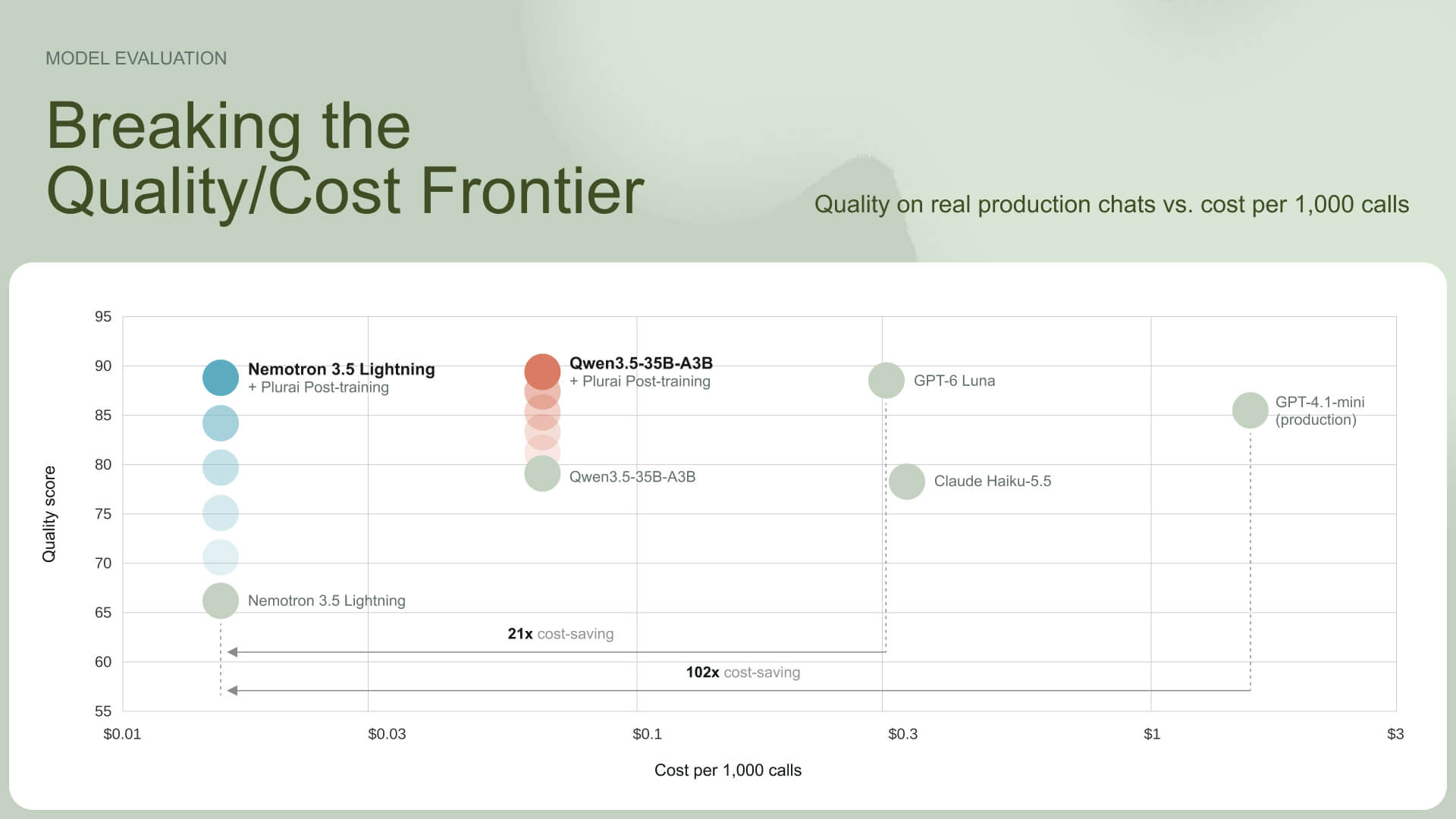
Figure 1. NVIDIA Nemotron 3.5 Lightning, post-trained by Plurai, matches GPT-6 Luna and beats the customer’s production model, GPT-4.1-mini, at 21x and 102x lower cost ($0.015 vs. $0.31 and $1.53 per 1,000 calls). Plurai post-trained two open models, Nemotron 3.5 Lightning (blue) and Qwen3.5-35B-A3B (orange); each trail runs from the out-of-the-box score to the post-trained score. GPT-6 Luna (with prompt caching), Claude Haiku-5.5 and GPT-4.1-mini are shown as-is. Quality: 0–100, average of 7 extracted fields on real production chats. Cost axis is log scale.
Post-training is the step between a prototype and production, and it only pays off if the post-trained model can then be served at production scale. Nebius gives Plurai both on one platform.
For high-volume workloads, the model that wins is the one with the best accuracy per dollar, and Nemotron 3.5 Lightning is built for exactly that tradeoff.
In this case study, that tradeoff held: post-trained Lightning was both the cheapest system tested and the top scorer on the held-out set.
Plurai: Vibe post-train any open-source model for your task in about 20 minutes at app.plurai.ai, or straight from your IDE with the Plurai Claude Code plugin.
Nebius: Run post-training and inference for open models on Nebius Token Factory, and meet Plurai and Nebius at NVIDIA GTC Berlin, October 20–22, 2026.
Plurai was founded by Dr. Ilan Kadar (CEO) and Dr. Elad Levi (CTO). Ilan, who holds a PhD in computer science and machine learning, is an AI leader with more than a decade of experience leading and building AI products, most recently as VP of AI at Nexar, where he led the company's AI efforts to build real-time, scalable and reliable systems for autonomous driving. Elad, who holds a PhD in mathematics, is an AI expert with more than a decade of experience developing innovative, high-impact AI products, most recently as Principal Scientist at Sightful and before that as AI Architect at Nexar. Together, they have published numerous research papers at top-tier machine learning conferences and released open-source projects with thousands of GitHub stars and hundreds of thousands of downloads.